19 September 2019 | Tata International Africa
How Investing in Small Business Entrepreneurship can Benefit Big Business
By Len Brand, CEO, Tata International Africa.
Businesses are dependent on the social, environmental, and economic sustainability of the communities in which they operate. Investing in initiatives which empower more people to become self-sufficient can have far-reaching benefits. The proverb ‘give a man a fish, and you feed him for a day; teach a man to fish, and you feed him for a lifetime’ is still one of the most powerful ways businesses can pay it forward.
Before I came on board in August 2016, the Tata Africa business was not in good shape. But execution of strategic initiatives which involve leading major organisational and cultural change to propel and sustain revenue growth is what I live for. It was a challenge that I relished.
Fast-forward two-and-a-half years and I am pleased to say that, through a clearly defined ‘uptime’ turnaround strategy, we managed to achieve a 20% jump in turnover, and the business was returned to solvency.
It is all about uptime
In essence, uptime is the opposite of downtime. For commercial vehicles like trucks and buses, uptime is the period when that vehicle is up and running, and downtime is when it is off the road for maintenance or repairs. Obviously when human capital or other assets go down, the business suffers financially. So, the quicker we can get that vehicle back on the road, helping its driver or owner to earn an income, the better.
Access to parts and service
Before the implementation of our uptime strategy, Tata International Africa’s network consisted of independent 3S and 2S dealers in South Africa and Kenya, with Tata acting as importer and dealer elsewhere on the continent. All these facilities were in the main cities of each country.
A 3S facility is a dealership which offers sales, service, and spare parts. A 2S facility, usually owned by a private individual, offers only services and spare parts. Up till that stage, a 1S facility was just a guy selling grey import spare parts out of a container.
In order to truly grow our footprint, to create the economies of scale we needed across the continent, we had to transform Tata’s network in Africa through an innovative development programme.
So, in line with the ethos of the Tata family conglomerate and their unwavering commitment to job creation, education, and skills development, especially in the areas of youth employment, and community and social upliftment, we set out to empower existing small business owners to become entrepreneurs.
Empowering entrepreneurs
It is important to understand that not all small business owners are entrepreneurs. While they are both self-employed, there are some distinct differences.
Small business owners are often sentimental, seeing their business as part of the community and part of the family. They are generally happy with the way things are, and content to simply carry on making a living, with limited growth and profitability.
Entrepreneurs, on the other hand, are not in business to simply achieve a level of income to support their current lifestyle. They are driven by passion or opportunity, and focus on innovative offerings, targeting rapid growth and high returns.
Our development programme was focussed on identifying those small business owners with entrepreneurial flair, and equipping them with the skills they needed to implement business processes and operating efficiencies to take their businesses to the next level.
We chose existing 1S facilities, strategically picking the ones already operating in prime locations, and offered to sell them genuine spare parts at a discounted rate, with a one-year buy-back guarantee.
We also offered free training for roadside mechanics, bringing them into one of our 3S or 2S facilities for three or four days, and training them on how to fix our vehicles.
Investment bears fruit
Our 1S pilot in Tanzania was a huge success. We have already seen the entrepreneurial results of the time and money we have invested in this programme.
When one of our customers’ trucks or buses break down, these Tata-trained roadside mechanics now go to their nearest 1S facility, buy the genuine parts, and fix the vehicle as quickly as possible.
There has also been a shift in our buying behaviour, as they have started buying spare parts from 1S facilities closest to them. Not only are they supporting small businesses in their communities, but in doing so, they are also able to get their customers’ trucks and buses up and running as quickly as possible.
All of this supports and bolsters our uptime strategy – positioning ourselves as the brand of choice in Africa for vehicles with the least amount of downtime. It is a virtuous cycle.
The whole is greater than the sum of its parts
In South Africa, we still have more than 30 3S dealers, and have increased our 2S touchpoints to 91. We can reach a broken truck or bus in less than two hours. We are doing the same across the rest of the continent, where we have expanded our own 3S facilities beyond just the main cities, and added numerous independent 2S and 1S touchpoints. As you travel through Africa, you know there will be a Tata touchpoint somewhere along the way.
Our aim is to continue growing our brand awareness, to be top of mind for commercial vehicles on the continent, and ultimately for the Tata brand to be as big and respected in Africa as it is in India.
Note: Prior to his current position as CEO at Tata International Africa, Len Brand spent 22 years focussed on agricultural mechanisation equipment, and golf and turf equipment, in sub-Saharan Africa, Germany, and the United States, six of which were spent in the role of MD at John Deere Sub-Saharan Africa. He is a University of Pretoria alumni, with a BSc in Industrial Engineering, and also sits on the BRICS Institute’s Advisory Board.
19 July 2019 | Tata International Africa
Tata Helps Develop Essential Life Skills for Learners at Alexandra High School
Employees of Tata International in Africa in partnership with Valued Citizens Initiative (VCI) donated mathematic guides, dictionaries, encyclopedia’s and motivational books to Grade 12 learners from Alexandra High School in Alexandra, Gauteng on Thursday 11 July.
The donation of books forms part of a two-year Bridging for Life programme supported by Tata and managed through VCI. The aim of the programme is to impart essential life skills to the learners, which range from emotional intelligence, effective communication, self-leadership and management, career development, citizenship education to ensure academic resilience.
The day included a workshop by South African artist, Daniel Selibe who introduced the learners to visual art and discussed with them the meaning of art and expression, the symbolism of colours, signs and symbols, including focal points and perspectives. Learners were encouraged to share and interpret, visually with their classmates and visitors, what the theme ‘opening your mind’ means to them.
CEO of Tata International Africa, Len Brand attended the handover and shared with the learners some of his life lessons and encouraged them to become avid readers. “You determine your own future in life and we must not allow our brains to limit our ability to reach our full potential,” was his message.
“It is important as an organisation to touch base with communities. Our philosophy to promote social and economic development of local communities through education, entrepreneurship and health initiatives is a key component of the Tata business values and belief system,” he added.
Alexandra High School is one of the largest schools in Alexandra and is led by principal, Mrs. Zoleka Lebelo who seeks to serve the Alexandra community by providing a consistently high standard of education. Under her leadership the school has achieved a matric pass rate of 89% up from 83% in 2014.
“We are grateful to Tata for the valuable donation. The Bridging for Life programme has made a significant difference in the lives of our learners. It has helped them to achieve better results and has increased their self-esteem. We hope for a sustained partnership with Tata going forward because an investment in education and a learner is an investment in the country,” she said.
The Bridging for Life Programme is managed by Valued Citizens Initiative, an NGO founded by Carole Podetti Ngono in 2001 with the aim of developing citizenship education in public schools. It is accredited by the Gauteng department of higher education and has been supported by Tata at Alex High School since its inception in 2017. The programme has proven its effectiveness over the years in assisting learners through the transition from high school to institutions of higher education and training.
16 October 2019 | Tata International Africa
Eight Scholarships for Students at The University of The Free State Courtesy of Tata
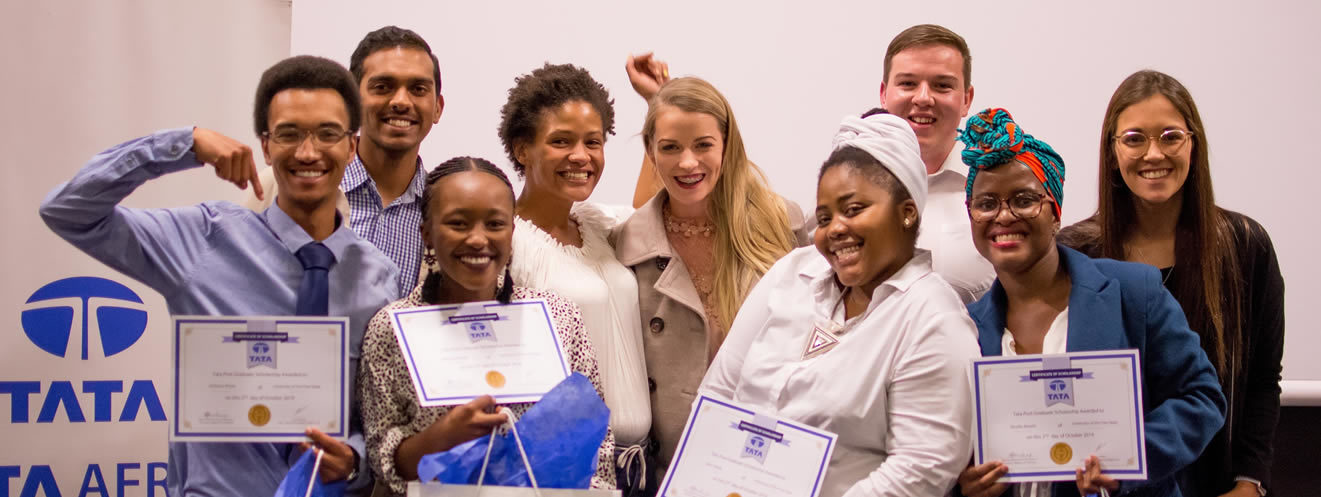
Tata International in Africa recently awarded eight academically and financially deserving students at the University of the Free State (UFS) with scholarships totalling more than R300 000.
This Postgraduate scholarship programme was created by Dr Johan van Zyl from the UFS Department of Business Management in 2012 in collaboration with Tata. The aim of the programme is to provide final year Strategic Marketing students an opportunity to apply their theoretical knowledge, by developing practical marketing strategies for any one of the Tata Group companies operating in Africa.
The students were tasked with presenting innovative marketing strategies with a goal of enhancing the business’ market share for Tata trucks and busses in South Africa as part of Tata’s Postgraduate Scholarship Programme.
“In line with the business ethos and core values of Tata, with its strong culture of uplifting society and giving back, our objective is to help increase the number of young people primed to take up leadership roles in business, government, and civil society. The Tata Postgraduate Scholarship Programme is one of our flagship education initiatives,” said Len Brand, CEO of Tata International Africa.
The amount that each student receives covers the student’s tuition fees, stipend (living costs), books and accommodation for the year of study. Tata postgraduate scholarships contribute to the country’s objective of increasing the number of postgraduate scholars primed to take up leadership positions in business, government, and civil society in the country. Scholarship recipients are not contractually bound to Tata once they complete their studies.
“Education is extremely empowering and transformative,” says Brand. “It has an amazing ripple effect, with the potential to not only uplift individuals, but the communities in which they live and work, and ultimately society at large.”
This year’s UFS scholarship recipients are: Carina Louw, Alroy Kriedemann, Sachintha Galhenage, Slindile Msweli, Megan Josephs, Mpho Mothab, Anthony Arlow and Lebo Tswala.
16 October 2019 | Tata International Africa
NMU Students Receive Scholarships Worth Over R500 000
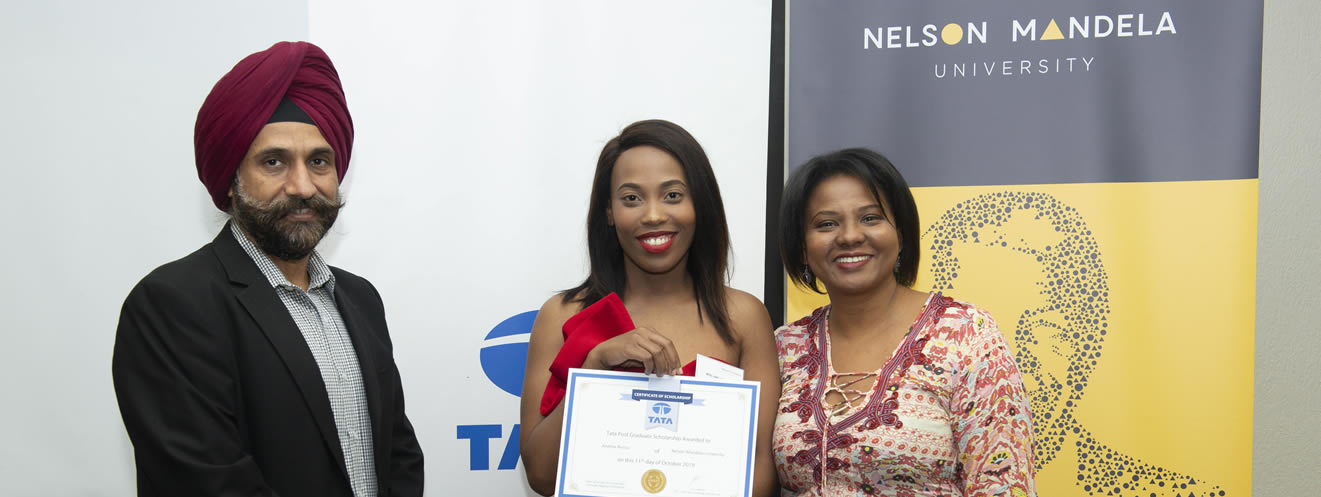
Johannesburg, South Africa, 22 October 2019: Fifteen academically and financially deserving postgraduate students from Nelson Mandela University (NMU) were recently given scholarships from Tata International in Africa worth more than R500 000.
The recipients, who graduated with Honours, Masters and Doctoral Degrees in the disciplines of Business and Economics, Sciences, Information Technology and the Arts were selected on the basis of financial need and academic excellence in their chosen field of study.
“Education is extremely empowering and transformative,” says Len Brand, CEO of Tata International Africa. “It has an amazing ripple effect, with the potential to not only uplift individuals, but the communities in which they live and work, and ultimately society at large.”
Scholarship recipients are not contractually bound to Tata once they complete their studies. All fields of study and faculties are taken into consideration and students must be accepted via the respective university’s academic or development foundation. The students must also pass the university’s academic criteria for acceptance.
The amount that each student receives covers the student’s tuition fees, stipend (living costs), books and accommodation for the year of study. Tata postgraduate scholarships contribute to the country’s objective of increasing the number of postgraduate scholars primed to take up leadership positions in business, government, and civil society in the country.
“Tata is committed to making a significant and sustainable impact on the continent by nurturing South Africa’s rich pool of young talent and growing a culture of giving back,” concludes Brand.
This year’s NMU scholarship recipients are: Jumba Ayabonga (BTech Honours – IT), Inga Jikwana (Honours – Business and Economic Sciences), Bidli Zenande (BTech – Public Relations), Buhle Mnyenyevu (BTech – Public Management), Chumani Dlabongo ((BTech – Public Management), Kali Noxolo (Honours – Business and Economic Sciences), Thandazani Nofingxana (BTech – Textile Design), Avukile Jeke (Masters – MA isiXhosa Research), Mphumzi Ngozi (Masters – Information Technology), Xolisile Dingiswayo (Masters – Agriculture), Tharollo Machili (Masters – Economics), Anelisa Pezisa (Masters – Development Studies), Prashana Ramjee (Doctors – Psychology), Sifiso Kanyo Santi (Doctors – Public Management) and Sinoyolo Ngongo (Doctors – Physics).